

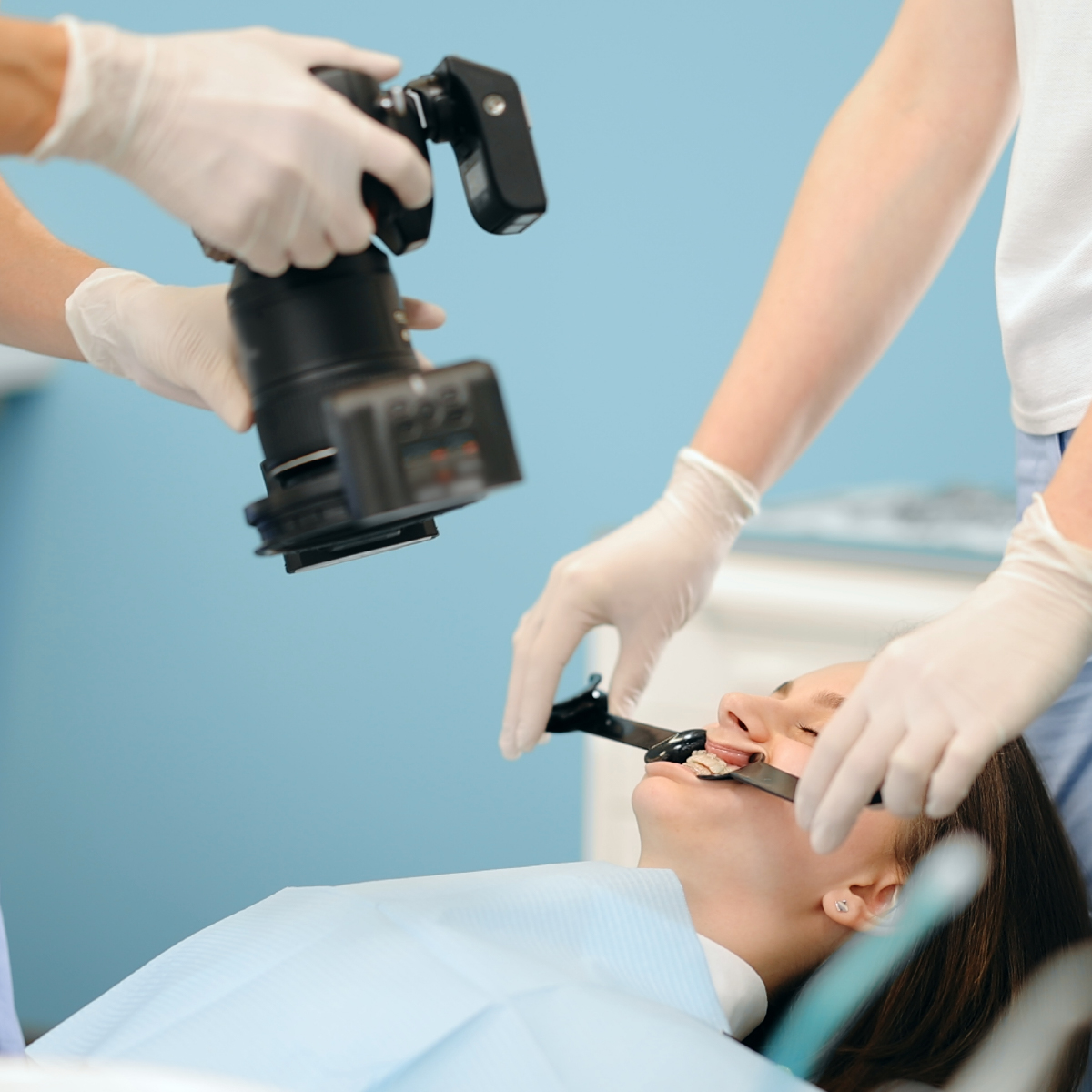
Consistent orthodontic progress photos come down to two things: following the same standard series every time, and capturing each shot at the same angle, distance, and lighting visit after visit. Get those two right and dental photography stops being a source of mismatched before-and-afters.
Most orthodontic photo sets follow a similar structure. Records bodies like the American Board of Orthodontics expect a specific photographic montage as part of a complete case record, not a loose collection of whatever shots happened to get taken that day.
The Standard Series Every Orthodontic Photo Set Should Include
A typical orthodontic photo series covers eight to nine images split between extraoral and intraoral views. Each one documents something the others don't, which is why skipping or swapping a view breaks the comparison from one visit to the next.
The table below summarizes the standard series most orthodontic practices build their photo workflow around.
| View | What It Shows |
|---|---|
| Full-face frontal, relaxed | Baseline facial symmetry and lip posture |
| Full-face frontal, smiling | Smile line and dental display |
| Profile | Facial and jaw projection |
| Anterior retracted | Front teeth alignment and midline |
| Left and right buccal | Bite relationship on each side |
| Upper and lower occlusal | Arch shape and crowding from above |
Together, these views give a complete picture of a patient's dental and facial presentation, which is exactly what makes them useful for tracking progress over the course of treatment.
What Actually Makes Photos Consistent, Not Just Complete
Capturing all eight or nine views doesn't guarantee consistency on its own. Framing matters just as much: published clinical photography guidance calls for the occlusal plane to sit parallel to the frame and for retractors, fingers, or other distractions to stay out of the shot entirely.
Distance and angle matter too. A buccal shot taken slightly closer or from a different angle than the last visit can make a bite relationship look like it's changed when it hasn't, which undermines the whole point of tracking progress through dental photography in the first place.
Why Consistency Is Harder Than It Sounds
In a busy practice, photos often get taken by whichever assistant is free at that moment, not the same person every time. A 2025 nationwide survey of orthodontists in Spain found that most practices don't work from a written photography protocol at all, which means each staff member is effectively inventing their own version of "consistent."
That gap is rarely intentional. It's just what happens when a process lives in someone's head instead of on a checklist or a guided workflow that every team member follows the same way.
How OrthoPhoto Builds This Standard Into Every Capture
OrthoPhoto's guided capture screen walks staff through the standard series in order, with on-screen overlays for framing each shot. Nobody has to remember which view comes next or eyeball whether the occlusal plane is level.
That structure is also what OrthoPhoto's orthodontic photography app approach is built around more broadly, standardizing dental photography so it doesn't depend on which staff member happens to be holding the phone that day.
Frequently Asked Questions
How many photos should a standard orthodontic progress photo series include?
Most practices work from a set of eight to nine images: three extraoral views covering the face and profile, and five or six intraoral views covering the bite and arches from multiple angles.
That count can vary slightly by practice or by what a specific case needs, but the core structure, facial views plus a full intraoral set, stays consistent across most orthodontic documentation standards.
What's the biggest mistake practices make with consistency?
The most common issue isn't a missing photo, it's a shift in angle or distance between visits. A buccal shot taken slightly closer than last time can make a bite relationship look different even when nothing has actually changed.
That kind of drift usually isn't intentional. It happens gradually, especially when different team members are capturing photos without a shared reference for exactly how each shot should be framed.
Do progress photos need to match the exact angle every visit?
As close as possible. The value of a progress photo comes from comparing it directly to the same shot from a previous visit, so even small differences in angle or distance can make that comparison misleading.
This is part of why guided, on-screen framing tends to produce more reliable series than eyeballing each shot freehand, especially across a full course of treatment spanning many visits.
Can a smartphone take diagnostic-quality dental photography, or do I need a DSLR?
Modern smartphone cameras are capable of high-resolution, well-lit images that meet the standard needed for orthodontic documentation, provided the framing and lighting are consistent.
The bigger factor for image usefulness is usually the workflow around the camera, whether the same views are captured the same way every time, rather than the camera hardware itself.
How does OrthoPhoto keep photos consistent across different staff members?
OrthoPhoto's guided capture screen shows the same overlays and prompts to every user, so the standard series looks the same whether it's captured by a hygienist, an assistant, or the treating dentist.
That removes the dependency on one particular staff member remembering the practice's unwritten photography habits, since the guidance is built into the app rather than passed along informally.
Better Progress Photos Start With a Better Process
OrthoPhoto exists because keeping progress photos consistent shouldn't depend on memory or whoever's free to grab the camera. A guided, repeatable process is what actually makes those photos useful for tracking treatment over time.
Ready to see what consistent dental photography looks like at your practice? Start a free trial of OrthoPhoto and try the guided capture flow with your next patient.
Sources
Photograph Requirements. American Board of Orthodontics. https://www.americanboardortho.com/orthodontists/become-certified/clinical-exam/mail-in-cre-submission-procedure/case-record-preparation/photograph-requirements/
Clinical Photography: A to Z. APOS Trends in Orthodontics. https://apospublications.com/clinical-photography-a-to-z/
Clinical Photography in Orthodontic Practice: Insights from a Nationwide Survey in Spain. PMC, 2025. https://pmc.ncbi.nlm.nih.gov/articles/PMC11943337/
